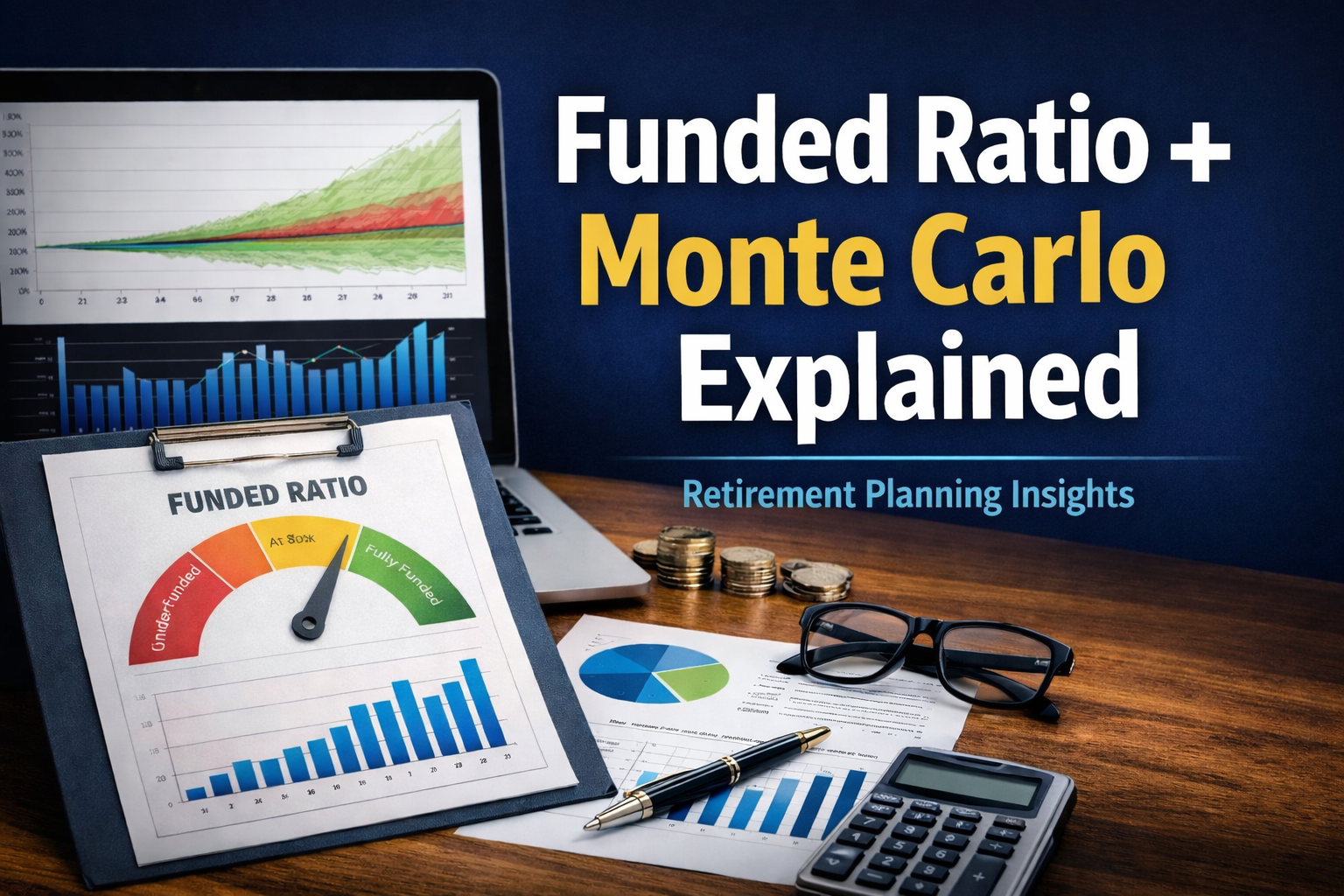
Retirement planning should answer one question clearly: Do you have sufficient assets to fund retirement – and how confident should you be? My approach is to use two complementary tools to help evaluate this question: The Funded Ratio and a Monte Carlo Simulation.
The Funded Ratio compares what you have (assets and reliable income sources) to what you need (your retirement spending goal). It gives you a snapshot of whether you are on track and helps frame practical decisions like how much to save, how much flexibility you have in spending, and whether retirement timing should be adjusted. Because it relies on a single discount rate (an assumed planning rate), it makes explicit the rate being used to translate future retirement spending needs into today’s dollars – without implying that return is guaranteed. That also gives us a clean way to test how sensitive “on track” is under more conservative or more optimistic discount-rate assumptions.
But retirement does not happen in a snapshot. It plays out through market ups and downs, inflation surprises, and unexpected life changes. That is where Monte Carlo analysis helps. It runs many potential market paths to show a range of outcomes and highlight risks that matter most in retirement – especially sequence-of-returns risk, when a market downturn early in retirement can have an outsized impact on long-term sustainability.
Each tool has limitations if used alone. A funded ratio depends on assumptions, especially the discount rate (the interest rate used to convert future spending needs into today’s dollars). In that sense, it embeds a single hurdle-rate view of the plan. Monte Carlo can feel precise, but results depend heavily on the quality of the inputs and how the model reflects real cash flows and behavior – and it typically does not produce one single interest rate you “must earn” to succeed. That is why I treat both as decision-support tools, not predictions.
Used together, the funded ratio answers, “Are we funded for the goal?” while Monte Carlo answers, “How resilient is the plan on the way there?” This combination tends to produce clearer conversations and better actions: how much risk to take, how to build a buffer for down markets, what spending guardrails make sense, and what changes improve outcomes the most.
My goal is to help you make the next right financial decision – then back it up with a coordinated plan and investment strategy. If you want a second opinion on your retirement readiness, we can review both your funded ratio and your Monte Carlo stress test, and turn the results into a simple, actionable plan.
Schedule a discovery call and we’ll turn your funded ratio and Monte Carlo results into clear, actionable next steps: https://calendly.com/wkinkel/30min
FAQs
What’s the one question retirement planning should answer?
Do you have enough to retire – and how confident should you be? The goal is a clear answer, not just more charts.
What is a funded ratio (in plain English)?
It’s an on-track scorecard. It compares what you have (assets and reliable income sources) to what you need (the value of your retirement spending goal).
What is the discount rate, and why does it matter in a funded ratio?
The funded ratio usually uses a discount rate (an assumed interest rate) to translate future spending needs into today’s dollars. Different discount rates can materially change the result, so it’s an assumption we test – not a guarantee.
How do you choose the discount rate?
There isn’t a single perfect rate. A practical approach is to start with a reasonable assumption for the plan’s goals and risk posture, then run sensitivity tests (more conservative vs. less conservative) so you can see how much the conclusion depends on the assumption.
Does the funded ratio tell me the return I’ll earn?
No. It doesn’t predict your actual returns. It’s a measuring tool that values future spending needs in today’s dollars using a planning assumption.
What is a Monte Carlo simulation in retirement planning?
Monte Carlo is a stress test. It runs many potential market paths to show a range of outcomes and an estimated probability your plan holds up.
What does probability of success actually mean?
It means: out of the market paths we tested, how many times did the plan work as designed? It’s not a promise – it’s a way to evaluate resilience under uncertainty.
Does Monte Carlo give me the interest rate I need to achieve?
Not usually in one simple number. Monte Carlo is typically presented as a probability of success rather than a single required interest rate. You can iterate assumptions to estimate a hurdle rate, but the real value is understanding how the plan behaves through different market paths.
Why do funded ratio and Monte Carlo sometimes tell different stories?
Because they measure different things. Funded ratio is a snapshot using a discount rate; Monte Carlo tests how the plan holds up through messy real life across many market sequences.
What is sequence-of-returns risk, and why is it a big deal?
It’s the risk that a market downturn early in retirement causes outsized damage because withdrawals can lock in losses and reduce the portfolio’s ability to recover.
What are spending guardrails?
They’re pre-agreed rules for small spending adjustments when markets or plan results change. Guardrails help avoid panic decisions and make adjustments intentional.
What do you mean by a buffer?
A buffer is a portion of the plan designed to reduce the need to sell risk assets in a downturn. The goal is simple: improve staying power during rough markets.
How do risk tolerance, risk capacity, and risk need fit in?
Tolerance is how you feel about volatility. Capacity is how much volatility your plan can withstand. Need is how much return you require. When those aren’t aligned, retirement can become unnecessarily stressful.
What inputs matter most for making this analysis meaningful?
Spending (including one-time expenses), inflation assumptions, timeline, income sources and start dates, and portfolio risk level. Good inputs matter.
How often should a retirement plan be updated?
At least annually, and anytime something meaningful changes – retirement timing, spending, income, health, or a major market move that changes your risk capacity.
Are funded ratio and Monte Carlo results guarantees?
No. They are decision-support tools based on assumptions. Their value is in clarifying tradeoffs and guiding better decisions over time.
Disclosure: All content is for information purposes only. Opinions expressed herein are solely those of Genesis Wealth Management Group, LLC and our editorial staff. It is not intended to provide any tax or legal advice or provide the basis for any financial decisions. Investment advisory services offered through Genesis Wealth Management Group, LLC